Part 2: Triple-Negative Breast Cancer & Chemotherapy — Why It’s Often Non-Negotiable
Raw Pink | Triple-Negative Breast Cancer: The Unfiltered Guide
After a triple-negative breast cancer diagnosis, one word tends to show up quickly — and loudly:
Chemotherapy.
For many people, it feels abrupt. Overwhelming. Even unfair.
You may hear:
- “We recommend chemo.”
- “Chemo is standard for this type.”
- “We don’t usually skip it with triple-negative.”
And the question that follows is almost always the same:
“Why is chemo so necessary?”
Let’s talk about that — clearly, honestly, and without sugarcoating.
What Makes Triple-Negative Breast Cancer Different
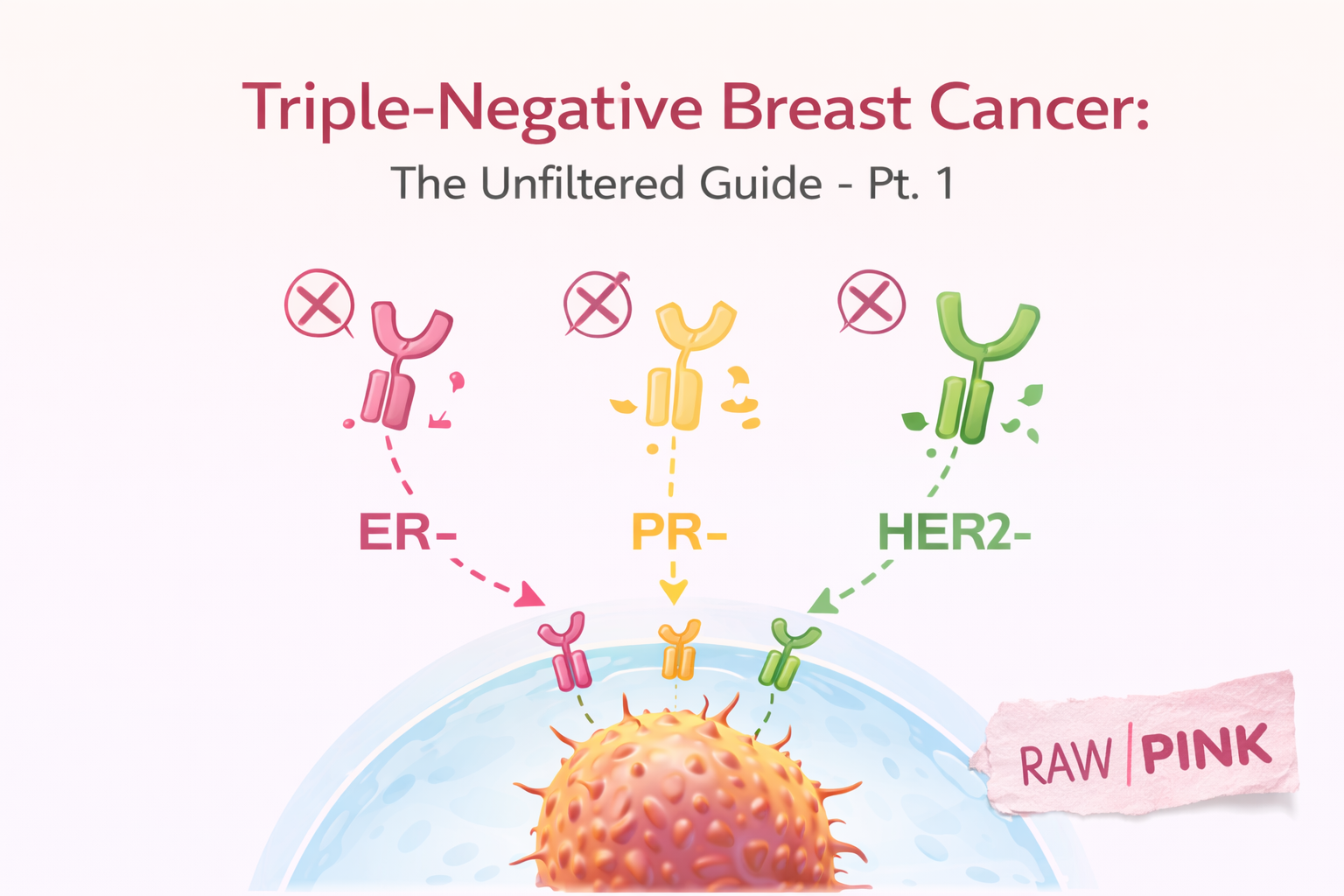
Triple-negative breast cancer (TNBC) does not rely on estrogen, progesterone, or HER2 to grow. That means:
- Hormone therapy does not work
- HER2-targeted drugs do not work
- There is no switch to turn off
So instead of blocking fuel, treatment has to destroy the cancer cells directly.
That’s where chemotherapy comes in.
Why Chemotherapy Plays Such a Central Role
Chemotherapy works by targeting fast-dividing cells.
Triple-negative breast cancer cells tend to:
- Divide more quickly
- Grow more aggressively
- Spread earlier than some other breast cancer types
Because of this behavior, chemotherapy is often the most effective systemic tool doctors have to reduce the risk of recurrence.
In plain terms:
Chemo is used because it works against this biology.
Not because doctors are aggressive — but because the cancer is.
Why There’s Often No “Wait and See” Option
In some hormone-positive breast cancers, doctors can test whether hormone therapy alone might be enough. That’s where tools like Oncotype come in.
With triple-negative breast cancer, that option usually doesn’t exist.
There is no hormone therapy safety net.
There is no genomic score that reliably says, “You can skip chemo.”
Instead, doctors look at:
- Tumor size
- Lymph node involvement
- Tumor grade
- Overall clinical risk
As those risk factors increase, the advantage of chemotherapy becomes clearer.
That’s why chemo is often described as non-negotiable — not emotionally, but biologically.
Chemo Before Surgery vs. After Surgery
Many people with TNBC get chemotherapy before surgery. This is called neoadjuvant chemotherapy.
Why?
Because it allows doctors to:
- See how the cancer responds to treatment
- Shrink the tumor before surgery
- Adjust therapy if the response is incomplete
Response matters in triple-negative breast cancer. When chemotherapy works well early, it provides valuable information about prognosis and future treatment decisions.
In other cases, chemotherapy is given after surgery, depending on tumor size, staging, and timing of diagnosis.
Neither approach is “better” universally — the choice is based on individual disease features.
Why Chemotherapy Feels So Heavy
Let’s be honest.
Chemotherapy is not easy.
It affects your body, your energy, your identity, and your sense of control.
It’s okay to:
- Grieve the version of treatment you hoped for
- Feel angry that this is the path
- Be scared of side effects and unknowns
None of that means you’re weak.
It means you’re human.
What Chemotherapy Is Actually Trying to Do
Chemotherapy isn’t punishment.
It isn’t overkill.
It isn’t a failure of your body.
It’s an attempt to:
- Kill microscopic cancer cells that scans can’t see
- Reduce the chance of recurrence
- Give you the best possible long-term outcome
It’s not about today.
It’s about protecting your future.
Why Understanding This Matters
When people don’t understand why chemotherapy is recommended, it can feel like something is being forced on them.
Understanding doesn’t make chemo easier — but it does make it less frightening.
Because fear grows in silence.
And clarity creates footing.
What’s Next in the Series
In Part 3, we’ll talk about the numbers and words that often replace Oncotype in triple-negative breast cancer:
Tumor grade, Ki-67, and what doctors really mean when they say “aggressive.”
Because if you’re going to hear these terms, you deserve to understand them.
For the Fighter Behind the Ribbon — Unfiltered
You didn’t choose this cancer.
You didn’t choose this treatment.
But understanding your care gives you power — and power matters.
You are not behind.
You are not missing something.
You are learning — and that counts.
Medical Disclaimer:
This content is for educational purposes only and is not a substitute for professional medical advice, diagnosis, or treatment. Always consult your oncology team regarding your individual care.
Sources:
- National Cancer Institute — Triple-Negative Breast Cancer
- American Cancer Society — Chemotherapy for Breast Cancer
- NCCN Patient Guidelines — Breast Cancer
- Journal of Clinical Oncology — Treatment of Triple-Negative Breast Cancer
- New England Journal of Medicine — KEYNOTE-522 Trial
- Breastcancer.org — Chemotherapy Basics