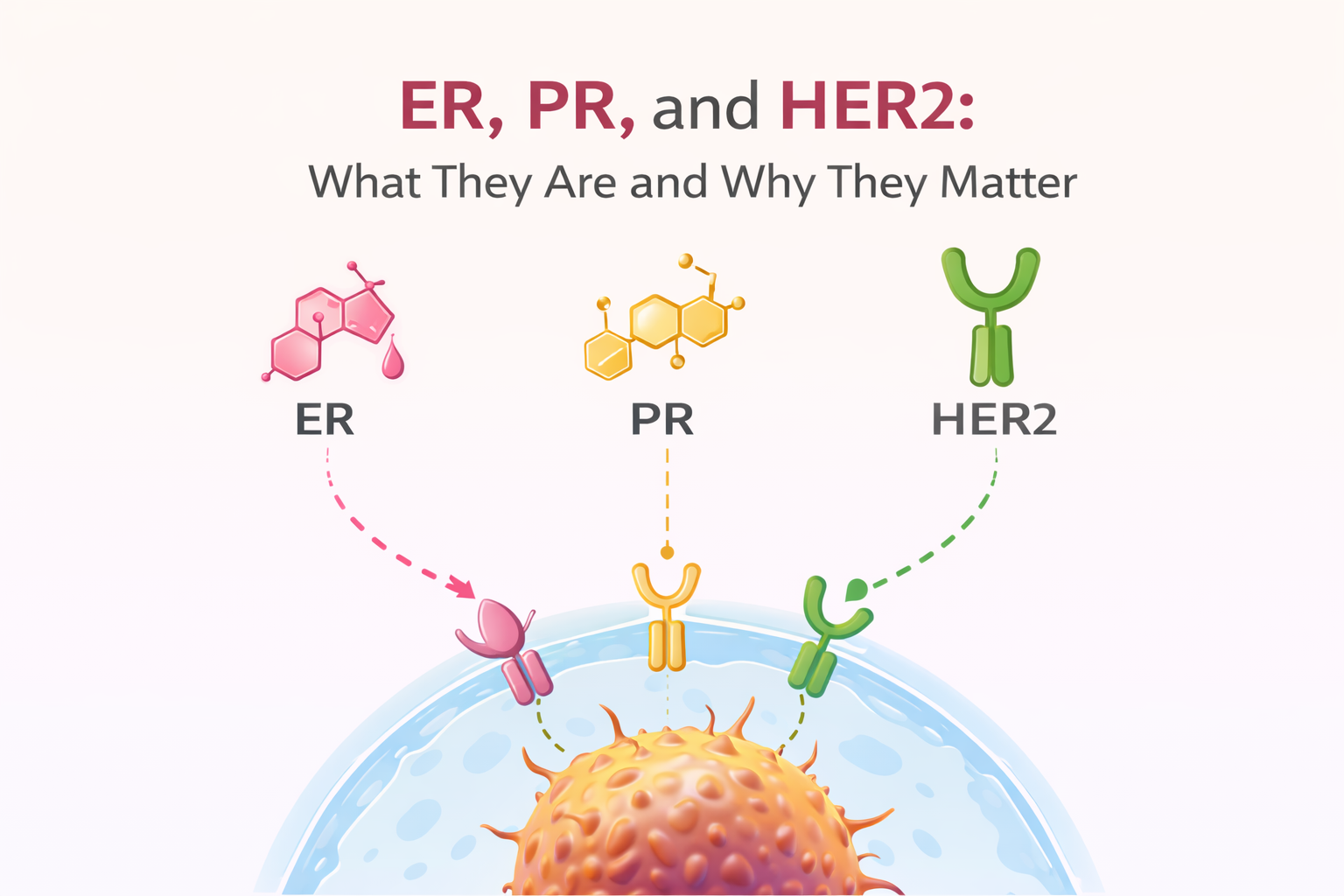
ER, PR, and HER2: What They Are and Why They Matter
After a breast cancer diagnosis, you’re suddenly handed a list of letters that feel more like alphabet soup than medical information:
ER.
PR.
HER2.
Doctors talk about them like everyone understands what they mean.
Most people don’t.
Let’s slow it down. Let’s explain what ER, PR, and HER2 actually are. Understanding these can help with treatment decisions.
No medical degree required.
First, What These Letters Actually Represent
ER, PR, and HER2 are receptors.
Think of receptors like locks on the surface of cancer cells.
If the correct key is present, the cancer cell receives a signal to grow.
Doctors test your tumor to see which locks are present. This tells them what fuels the cancer. It also shows them how to shut it down.
ER: Estrogen Receptor
If a cancer is ER-positive, it means estrogen can attach to the cancer cell and help it grow.
This matters because estrogen is something your body naturally produces.
When ER is available:
- Hormone therapy can be effective
- Treatments may block estrogen or stop it from attaching to the cancer cells
- The cancer is considered hormone-driven
ER-positive breast cancer often responds well to long-term hormone therapy, even after surgery and other treatments are done.
PR: Progesterone Receptor
PR works similarly to ER, but it responds to progesterone instead of estrogen.
If a cancer is PR-positive, progesterone can also help fuel its growth.
PR status helps doctors:
- Understand how hormone-responsive the cancer is
- Predict how well hormone therapy may work
- Get a fuller picture of the cancer’s behavior
Many cancers are both ER-positive and PR-positive, which often signals a stronger response to hormone-based treatments.
HER2: Human Epidermal Growth Factor Receptor 2
HER2 is different.
HER2-positive cancer has too many copies of a growth receptor that tells cancer cells to divide quickly.
When HER2 is positive:
- The cancer tends to grow faster
- Targeted drugs can block the HER2 signal
- Treatment plans often include HER2-specific medications
HER2-positive breast cancer used to be much harder to treat. Today, targeted therapies have dramatically improved outcomes.
What These Results Do Not Mean
This part matters.
ER, PR, and HER2 results do not:
- Predict survival with certainty
- Mean one type is “better” or “worse.”
- Echo on anything you did or didn’t do
They describe biology, not destiny.
Different biology requires different tools.
How ER, PR, and HER2 Guide Treatment
Together, these three markers help doctors decide:
- Whether hormone therapy will help
- Whether targeted therapy is appropriate
- How aggressive does the treatment need to be
They help personalize treatment instead of using a one-size-fits-all approach.
This is why two people with breast cancer can get significantly different treatment plans. Their tumors might be the same size, but the treatments can vary greatly.
Where Triple-Negative Breast Cancer Fits In
If a cancer is:
- ER-negative
- PR-negative
- HER2-negative
It’s called triple-negative breast cancer.
This means the cancer is not driven by hormones or HER2, so hormone therapy and HER2-targeted drugs won’t work.
Treatment decisions for triple-negative breast cancer rely on several other factors. These include tumor size, grade, lymph node involvement, and response to chemotherapy.
Different biology. Different strategy.
A Plain-Language Way to Think About It
Think of cancer like a house with doors.
ER, PR, and HER2 are different doors the cancer can use to grow.
Doctors test which doors are unlocked — then block the ones that are being used.
If no doors are open, they use other tools.
Why This Lives Behind the Ribbon
ER, PR, and HER2 don’t show up on pink merchandise.
They don’t come with slogans.
But they shape nearly every treatment decision that comes after diagnosis.
Understanding them doesn’t make cancer easier — but it makes the process more transparent.
And clarity matters.
Medical Disclaimer
This content is for educational purposes only and is not a substitute for professional medical advice. Always consult your oncology care team about diagnosis, treatment options, and medical decisions.